
Spring types
Compression springs
A wire helix that shortens under axial load. Geometry and end support determine the useful travel it can provide.
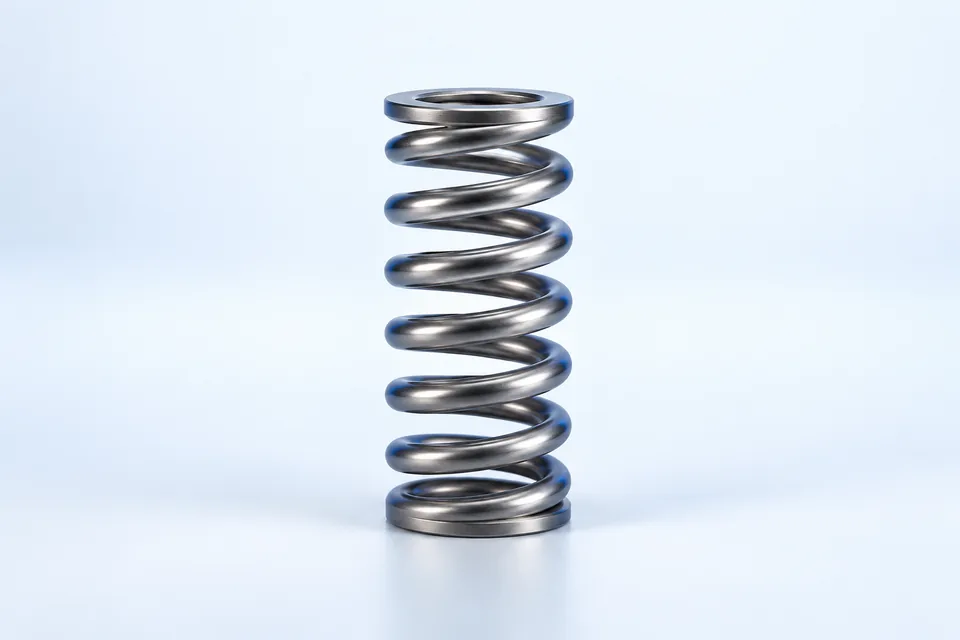
Body response
For a cylindrical round-wire helix, a linear approximation relates force and displacement through the rate. Wire diameter, mean coil diameter, and active turns have a strong effect; ends and contact can change the actual response.
Before sizing
Check free length, loaded length, and estimated solid height. This site's guide covers a first-pass cylindrical model with closed and ground ends; it does not fully evaluate buckling, fatigue, or manufacturing tolerances.
Model formula
For this idealized body, k = G·d⁴/(8·D³·n) and F = k·s. Use G in N/mm², d and D in mm, n as active turns, and s in mm; k is then in N/mm and F in N.
Worked example
With d=2 mm, D=16 mm, n=8, and G=79,300 N/mm², k≈4.8401 N/mm. At s=10 mm, F≈48.4009 N. This is a model result, not an allowable load or part validation.