
Spring types
Extension springs and hooks
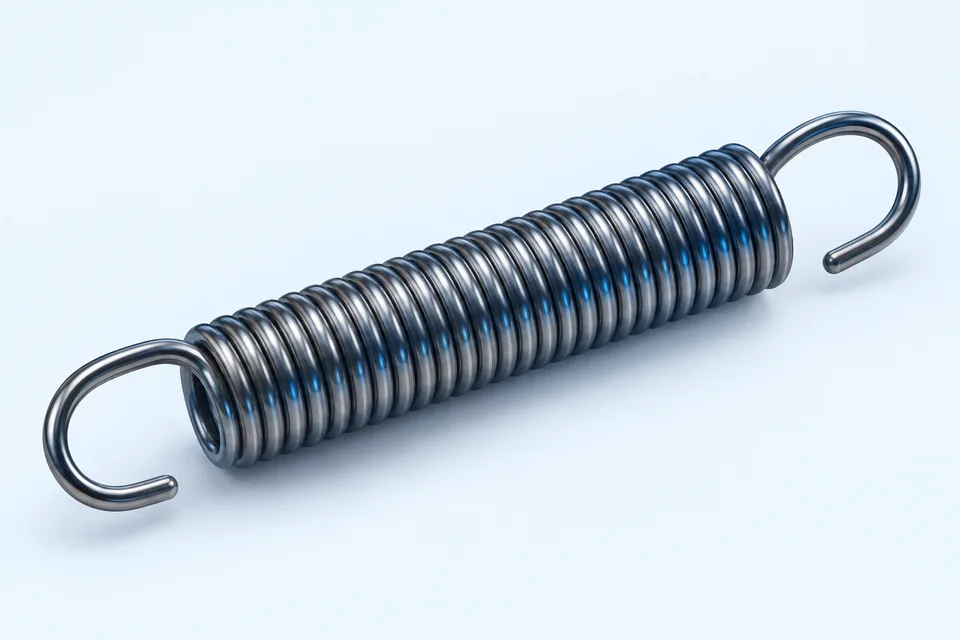
An extension helix produces force as it lengthens. The body and its ends behave differently and need separate evaluation.
Initial tension
Coils are often close wound and require an initial force to separate. In a linear model, load combines that initial tension with body rate and subsequent extension; actual behavior can differ from the idealization.
Ends matter
Hooks, loops, and transitions concentrate stress and may govern strength or service life. The calculator approximates the body and does not verify local hook geometry, opening, orientation, or end load capacity.
Body relationship
For the idealized helix, k = G·d⁴/(8·D³·n) and F = F₀ + k·s. With N/mm² and mm inputs, k is in N/mm; F₀ is initial tension in N and s is extension after coil separation.
Worked example
With d=2 mm, D=16 mm, n=8, and G=79,300 N/mm², k≈4.8401 N/mm. If F₀=15 N and s=10 mm, F≈63.4009 N. This estimates the body; it does not verify the hook.