
Dimensions and calculation
Dimensions that describe a helix
An unambiguous sketch avoids mixing up outer, inner, and mean dimensions.
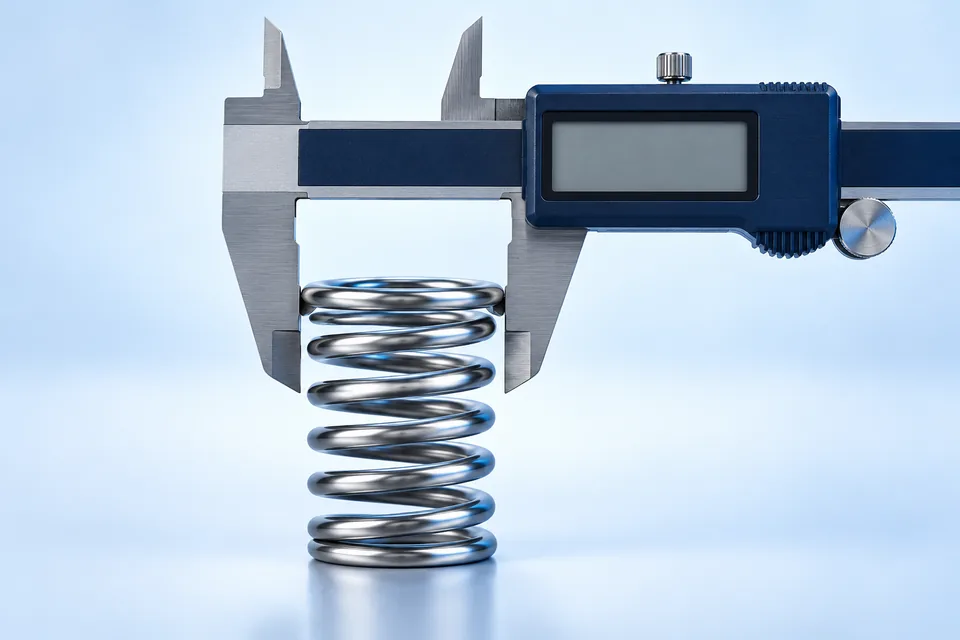
Diameters and wire
For a round-wire helix, d is wire diameter and D is mean coil diameter. For an ideal circular section, outer diameter is approximately D+d and inner diameter D−d. State which diameter you measured and how.
Length and turns
L0 commonly denotes free axial length; n counts active turns, which may differ from the physical total. Record ends, pitch, winding direction, and measurement condition. Actual dimensions depend on form and agreed tolerances.
Geometric relationships
For an ideal round wire, De = D+d and Di = D−d, so D = (De+Di)/2 and d = (De−Di)/2. In the compression model with closed and ground ends, nominal total turns are n+2 and estimated solid height is Ls=(n+2)·d.
Worked example
If d=2 mm and D=16 mm, then De≈18 mm and Di≈14 mm. With n=8 active turns, the model assumes 10 total turns and estimates Ls≈20 mm. This is not universal: other end forms or contact change the stack height.