
Dimensions and calculation
Rate, curve, and energy
Rate describes load change per unit of travel or angle over a defined range.
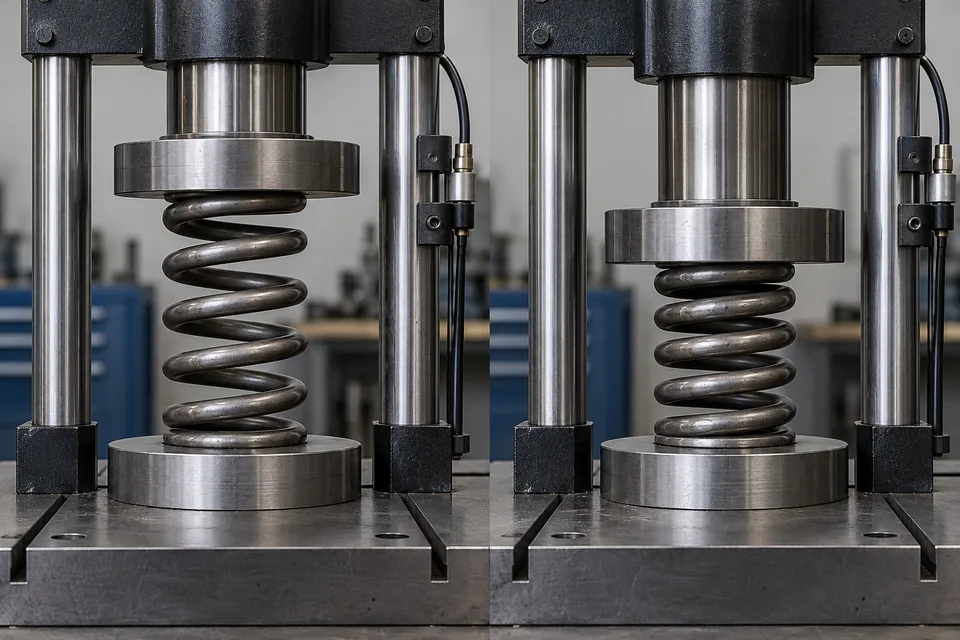
Read the curve
In a linear model, the slope of force versus travel is k; for torsion, torque versus angle gives angular rate. Initial tension shifts an extension spring's curve. Contact, friction, or changing geometry can make it nonlinear.
Work and energy
The area under the load curve represents mechanical work exchanged over that travel. For a linear response from zero it is triangular; with preload, initial work must be included. It is not necessarily all energy available to the system.
Equations and units
For compression from zero load, U=½·k·s². To open a helix with initial tension F₀, U=F₀·s+½·k·s². With N and mm, the result is N·mm: divide by 1000 to express it in joules.
Model example
With k=4.8400879 N/mm and s=10 mm, compression gives U≈0.242004 J. If F₀=15 N, extension work is U≈0.392004 J. This is external work from the stated travel start, not all historical energy in the assembly.
Angular work
For linear torsion, U=½·M·α·π/180, with M in N·mm and α in degrees; the intermediate result is N·mm and is divided by 1000 for J. Convert degrees to radians because work uses angular displacement in radians.
Angular example
For M=31.02495 N·mm at 5°, U≈0.00135372 J. This belongs to the linear body model; it excludes installation friction and energy dissipated in the system.