
Spring types
Torsion springs
A round-wire helix resists rotation through a moment. Its legs transmit force and shape the installation.
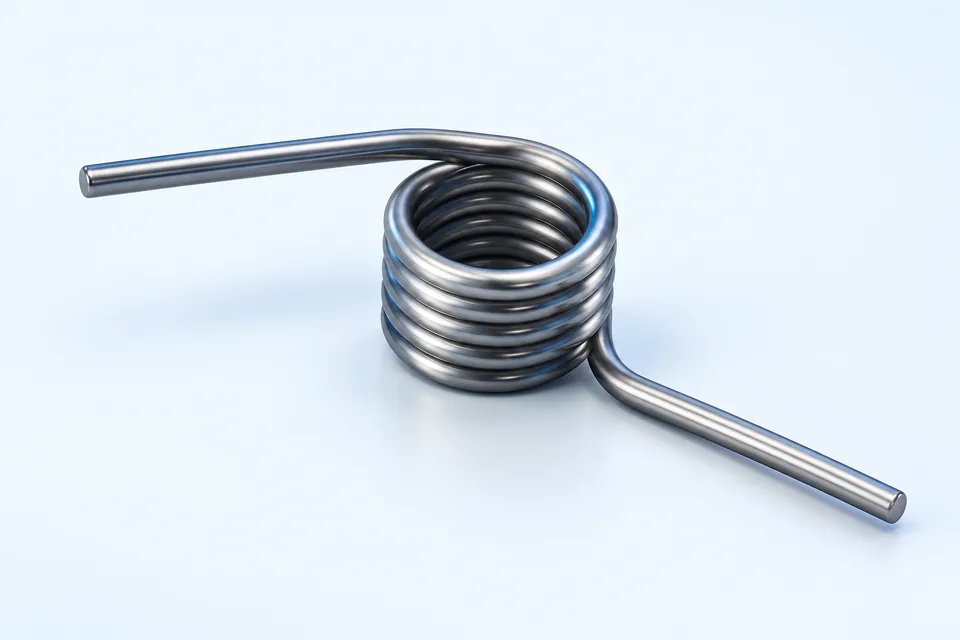
Moment and legs
The relevant body load is torque; applied force depends on its perpendicular distance from the axis. Leg length, angle, support, and contact affect the assembly, even when a simple model represents only the body.
Winding direction
The load direction should tend to close the body, and winding direction must match the installation. The calculator estimates body rate and stress; it does not model leg stresses, interference, or mandrel geometry.
Angular rate
This page's model uses kα = E·d⁴/(10.8·D·n·360), in N·mm/degree, with E in N/mm² and dimensions in mm. It then calculates M = kα·α. This approximates the body, not its legs.
Worked example
With d=2 mm, D=16 mm, n=8, and E=193,000 N/mm², kα≈6.20499 N·mm/degree. At 5°, M≈31.02495 N·mm; with a 20 mm perpendicular arm, F≈1.55125 N.