
Dimensions and calculation
Springs in series and parallel
The arrangement of multiple springs changes equivalent rate and the load carried by each element.
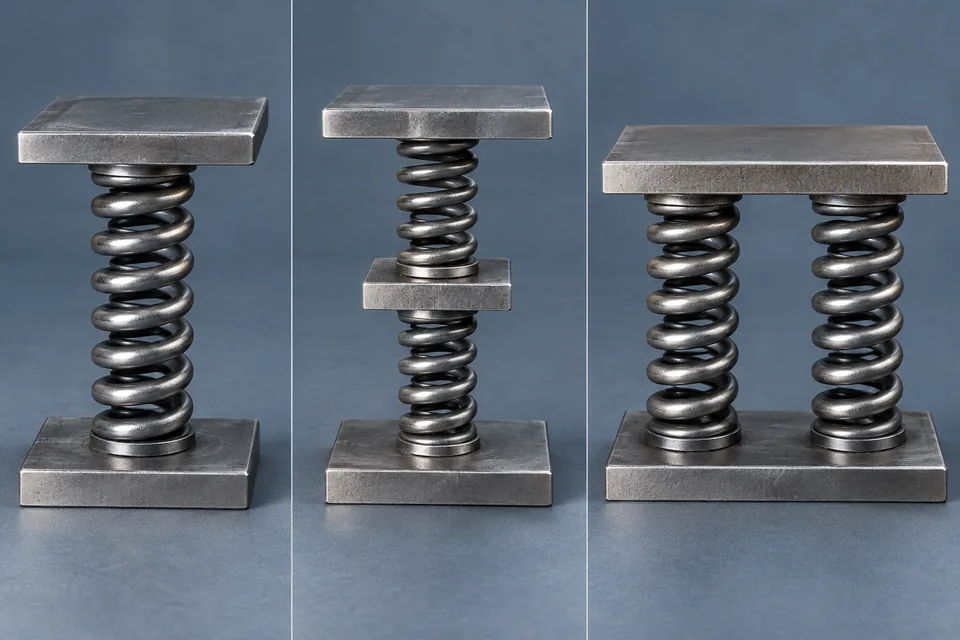
Ideal case
For ideal linear springs with the same deflection in parallel, rates add: k total = k1 + k2. In series, each carries the same force and compliances add: 1/k total = 1/k1 + 1/k2.
Arrangement limits
Actual load sharing depends on supports, alignment, tolerances, preload, contact between parts, and changing rate. If a spring reaches solid height or loses contact, the equivalent model no longer describes the assembly.
Worked example
With k1=4 and k2=6 N/mm, parallel rate is 10 N/mm. In series, rate is 2.4 N/mm; at F=12 N, deflections are 3 and 2 mm, 5 mm total. Two parallel springs compressed 2 mm ideally carry 20 N.